About Us

The Control Tower on Ford Island – Building S84 (Article II)

2010

December 2, 2011


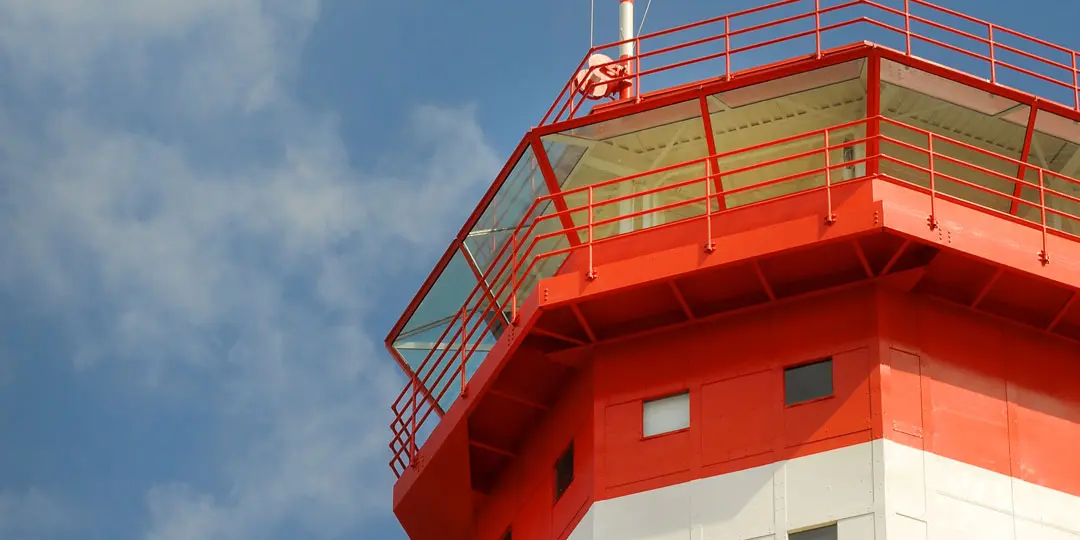
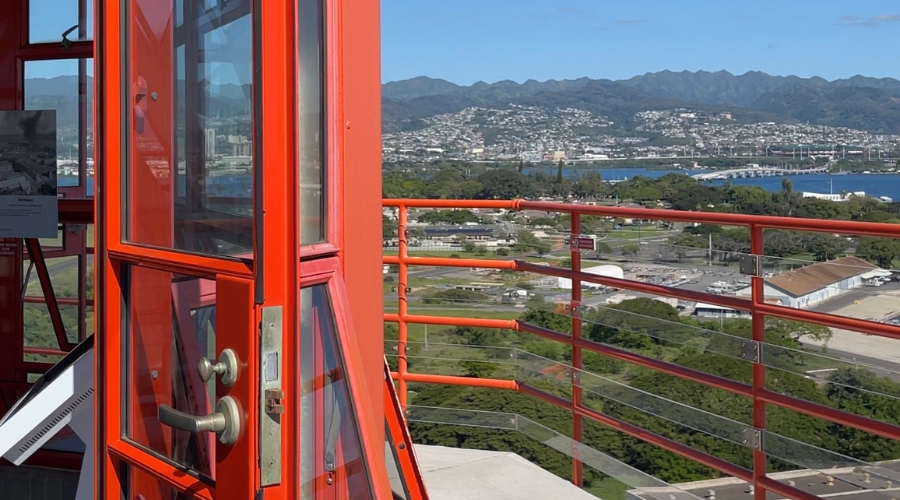
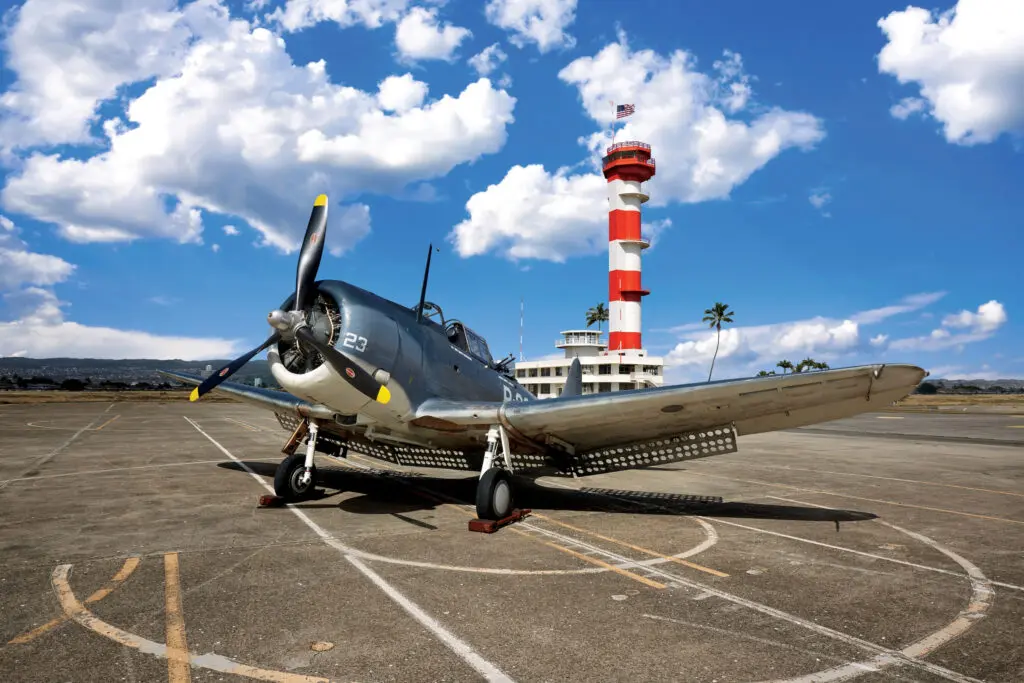
Both Tora, Tora, Tora and Pearl Harbor prominently featured the tall red and white control tower on Ford Island. This article looks at the history of the control tower and its recent stabilization.

This is the second in a series of articles on Ford Island as it existed on December 7, 1941. Jumping right to the control tower is taking things a bit out of order. However, with the unveiling of the renovated control tower scheduled for December 7, 2011, it is the right time to look at this historic building.

Building the Operations Building (S84)

The control tower is part of the Operations Building (S84). This was a multipurpose structure built just to the north of the seaplane base hangars. Like many buildings on Ford Island, it

was a brand new building when the attack occurred. In fact, it was not quite finished.

Figure 1 shows the building right after the attack. It is obvious from the figure is that the control tower was not painted red and white. In fact, it wasn’t painted yet. In addition, there is no control tower at the top. In fact, only two of its three rings are in place around the water tank. Although the control tower at the top of the big water tower was scheduled for construction, it was not in existence at the time of the attack. Aircraft had to be controlled from the building at the base of the water tank.

Figure 1: Building S84 around December 8, 1941. Source: National Archives 80-G-32482.

The figure shows a lower control tower on the roof of Building S84. This structure was created as an aerological tower (for wind direction and weather forecasting). However, until the upper control tower was built, it doubled as an interim control tower for wheeled aircraft using the runway. Figure 2 shows this structure in 1993, during the Historic American Buildings Survey project to survey building S84 [Hatani, 1993]. Figure 3 shows an aerological center, although not the one on Ford Island.

Figure 2: Aerological Tower and Interim Control Tower. Source: Historic American Building Survey, 1993. 048213PR.


Source: National Archives and Records Administration: NH-52831


Building S84 was called the Operations Building. It was actually a multi-purpose building that was designed to serve a number of functions. According to the Historic Buildings Survey assessment of the building [Hatani, 1993], it consisted of “a garage, operations/administrative offices, barracks, aerological tower, water tank, and aircraft control tower” on December 7, 1941.

Completing the Upper Control Tower

The upper control tower was finished on May 1, 1942, five months after the attack [U.S. Navy, 1945]. Figure 2 shows the building and control tower shortly afterward, on May 8, 1942. Note that although the building was finished, it was not painted. By the way, the small truck in front of the building in the middle was a wrecker/fire truck designed to work on crashed airplanes.

Figure 5: The Upper Control Tower on May 8, 1942

Finally Painted

We do not know exactly when the control tower was finally painted, but we do have a picture of it in August 1942. This is Figure 3. It is not a very good picture, but the control tower is visible in the lower right part of the picture. The tower is painted in sinuous camouflage. We do not know what the camouflage colors were, but red and white would not make for very good camouflage.

Figure 6: The Control Tower Painted in Camouflage August 1942

Figure 6 gives a better image of the camouflaged tower on December 10, 1942. This picture is taken from the north, which is unusual. In the foreground on the left are revetments for aircraft to protect them from attack. These revetments were built after the attack. They were later torn down.

Figure 7: Camouflaged Tower on November 10, 1942. Source: National Archives.

When Did the Tower Become Red and White?

We are even more uncertain when the tower was painted red and white. Figure 4 shows the control tower in 1944. It is still in camouflage. Presumably, it remained this way through the war. Continue reading

Ford Island: Pearl Harbor, Hawaii – December 7, 1941 (Article I)

Introduction

Ford Island was the epicenter of the attack on December 7, 1941. Its seaplane base had dozens of long-range PBY patrol bombers capable of locating the Japanese fleet after the attack. Along her coast were moored seven of the Pearl Harbor fleet’s nine battleships. Ford Island is also where the Pacific Fleet’s three carriers would have moored had they been in port that day. The attack destroyed nearly all of the patrol planes. It also disabled the Pacific Fleet’s battleship force, making it impossible for the U.S. to carry the fight to Japan to spoil the Japanese expansion in the Pacific.

Today, Ford Island is still an active military base. However, it is now possible for tourists to visit parts of this historic battlefield. Pacific Aviation Museum Pearl Harbor gives visitors access to historic Hangar 37 and Hangar 79 and is in the process of renovating the famous control tower. The museum will eventually expand to include Hangar 54. This is the first in a series of articles on Ford Island as it existed on December 7, 1941.

The Surrounding Area

Figure 1 shows Pearl Harbor and the surrounding area. Ford Island is in the middle of the harbor.

Figure 1: Pearl Harbor and Hickam Field, October 30, 1941 80-G-182874

On the eastern shore is the Navy Yard, where heavy repairs were done. The USS Pennsylvania (BB-28), the flagship of the battle fleet was in dry dock for overhaul. In the second wave of the attack, dive bombers damaged the Pennsylvania heavily damaged the destroyers USS Cassin (DD-372), USS Shaw (DD-373), and USS Downes (DD-375). On the 1010 Dock closest to Ford Island, the light cruiser USS Helena (CL-50) and the minelayer USS Oglala (CM-4) were moored during the attack. Both were sunk by a Japanese torpedo but were later restored. The Helena was lost at the Battle of Kula Gulf in 1943.

Many Japanese torpedo planes flew along the East Loch to get the longest possible straight runs for dropping their computers. This put the battleships USS Oklahoma and USS West Virginia in an almost direct line. Of the 40 torpedoes dropped by Japanese aircraft, approximately 14 hit these two ships.

Note that Hickam Field, which was the U.S. Army Air Forces bomber field in Hawaii, is adjacent to Pearl Harbor. Today, the two bases are combined into Joint Base Pearl Harbor Hickam.

The figure also shows the narrow sea channel between the Pacific Ocean and Pearl Harbor. If a major ship had been sunk in the harbor while escaping, other ships could not leave or enter the harbor.

Finally, the figure shows oil storage near the submarine base. Admiral Nagano has been criticized for not launching a third wave to destroy the oil storage tanks throughout Pearl Harbor and ship repair facilities in the Navy Yard.

Ford Island

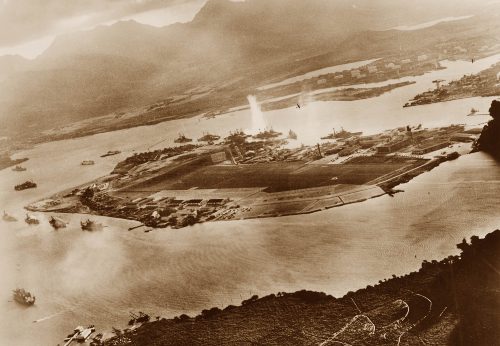
Figure 2 takes a closer look at Ford Island. This picture was taken on October 10, 1941. If it looks familiar to visitors to Pacific Aviation Museum, this is because the photograph was the basis for the Dru Blair mural that visitors see when they enter the main floor of Hangar 37.

Figure 2: Ford Island, October 10, 1941. 80-G-279375

The label Battleship Row lies at the bottom of a set of quays used by the bulk of Pearl Harbor’s battleships. On the day of the attack, the battleships Oklahoma (BB-37), Maryland (BB-46), West Virginia (BB-48), Tennessee (BB-43), Arizona (BB-39), and Nevada (BB-36) were moored there. The USS California (BB-44) was moored farther down at Quay F-3, just behind where the USS Enterprise is in the October, 1941 picture (at Quay F-2) [1]. These battleships bore the brunt of the torpedo, high-level bombing, and dive bombing attacks on Pearl Harbor that day. The USS Pennsylvania (BB-38), the other battleship in port that day, was in the Navy Yard undergoing overhaul. The other battleship in the Pearl Harbor force was the USS Colorado (BB-45). She was in undergoing overhaul on the West Coast.

No aircraft carriers were in port that day. The USS Enterprise (CV-6) was scheduled to have returned from dropping off 12 F4F fighters at Wake Island, but it was delayed by heavy seas. As noted in an earlier blog article, the Enterprise was normally moored where it was in Figure 2. The USS Lexington (CV-2) and the USS Saratoga (CV-3) normally moored on the other side of the island, where the USS Utah (AG-16) was moored on the day of the attack. On the day of the attack, Lexington was on its way to delivery dive bombers to Midway Island. Saratoga had just finished a refit and was entering San Diego’s harbor to pick up its air wing. The survival of these carriers was critical for the first year of the war.

The lower right corner of Pearl Harbor is the seaplane base. This base had four squadrons of Consolidated PBY Catalina patrol bombers. These aircraft had an operational radius of operation of 700 miles, so they could have found the Japanese fleet long after its attack. The seaplane base also was the servicing area for catapult-launched aircraft on cruisers and battleships when these ships were in port. Due to a communication mix-up, Japanese dive bombers hit the seaplane base at 7:55, almost five minutes before their torpedo bombers arrived to attack the battleships. The seaplane base is now home to Pacific Aviation Museum and active Navy facilities. Its landmark feature was the control tower in the airfield Operations Building. The photo shows that the tower was unfinished in October, 1941, just as it was on the day of the attack.

At the opposite side of the island was the servicing area for carrier aircraft when the carriers were in port. This area had been a U.S. Army Air Corps base, Luke Field, until 1939. It was often still referred to as “Luke Field” despite the fact that it was then a Navy facility. The runway, by the way, was never called Luke Field. “Field” was the U.S. Army Air Corps and U.S. Army Air Forces name for an air base, not for the base runway.

References 
[1] U.S. Navy History and Heritage Command, Pearl Harbor Raid, 7 December 1941: “Battleship Row” during the Pearl Harbor Attack, http://www.history.navy.mil/photos/events/wwii-pac/pearlhbr/ph-bba.htm
Post by Ray Panko

Facebook
flickr
twitter
You Tube
Hangar Talk

©2011 Pacific Aviation Museum Pearl Harbor
An IRS 501(c)3 nonprofit organization